
Grey Matters Centre and the Integration Centre, where applicable.
1. Purpose, scope and responsibilities
Every complaint about therapy at Grey Matters Centre (GMC) and Integration Centre, where applicable, is acknowledged within 3 working days and receives a written response within 20 working days. Safeguarding concerns are acted on the same day. In this policy, references to GMC include the Integration Centre where applicable.
All therapists at GMC are self-employed. They hire rooms from GMC and contract directly with their clients. GMC also promotes them on its website and social media, so it has a duty to take concerns seriously, act on risk and keep its marketing accurate.
| Area of concern | Who is responsible | What GMC does |
| The therapy itself: approach, conduct, boundaries, fees, notes, session confidentiality | The therapist and their professional body | Receives the complaint, asks the therapist to respond, signposts the professional body and decides whether to keep hiring rooms to or promoting the therapist |
| Rooms, facilities, reception, cleanliness, accessibility and any booking made through GMC | GMC | Investigates and responds in full |
| GMC marketing: website, social media, therapist profiles and adverts | GMC | Investigates, corrects any error and responds in full |
| Any risk of harm to a client, child or adult at risk | Everyone; coordinated by GMC’s Designated Safeguarding Lead | Acts immediately under section 3 |
GMC cannot investigate a therapist’s clinical judgement, order a refund or award compensation for a therapist’s services. Those matters sit with the therapist, their professional body or the courts.
This policy covers current and former clients, anyone acting for a client with their consent and the parent or guardian of a client under 18. Complaints should be made within 12 months of the event or of becoming aware of it; GMC may accept later complaints where there is good reason.
This draft is not legal advice. It should be checked by a solicitor and GMC’s insurer before adoption.
2. Principles and definitions
GMC handles complaints fairly, confidentially and without penalty to the person complaining.
- Accessible: complaints can be made in person, by phone, by email, by letter or on the complaint form (Appendix B). GMC makes reasonable adjustments under the Equality Act 2010, such as help writing a complaint down.
- Fair: the client and the therapist are both heard before any decision. Nobody investigates a complaint about themselves.
- Confidential: information is shared only with those who need it to resolve the complaint or to keep someone safe.
- No detriment: complaining will not affect a client’s access to GMC or to any other therapist at the centre.
- Timely: GMC keeps to the timescales in section 5 and explains any delay in writing.
- Learning: GMC reviews complaints each year to improve its service.
| Term | Meaning |
| Complaint | Any expression of dissatisfaction, spoken or written, that asks for a response |
| Concern | An issue raised informally that may be resolved without the formal procedure |
| Safeguarding concern | Any sign that a client, child or adult at risk is being harmed or is at risk of harm |
| Complaints Lead | Louise Fenton, or a nominated deputy where Louise is involved in the complaint |
| Designated Safeguarding Lead (DSL) | Louise Fenton, who coordinates safeguarding action (contact details in Appendix C) |
| Working day | Monday to Friday, excluding bank holidays |
3. Safeguarding and serious concerns
A complaint that suggests anyone is at risk of harm is treated as a safeguarding matter first and a complaint second. The DSL must be told the same day.
Examples include:
- sexual, romantic or inappropriate personal contact between a therapist and a client
- physical, emotional or financial abuse or exploitation by a therapist
- a disclosure that a child or an adult at risk is being harmed
- a client at immediate risk to their life or safety
- a therapist appearing to work while impaired by alcohol or drugs
- any allegation of a criminal offence
What to do
- If anyone is in immediate danger, call 999.
- Listen, stay calm and write down what was said in the person’s own words with the date and time. Do not question in depth or investigate.
- Do not promise to keep the information secret. Explain who it will be shared with and why.
- Tell the DSL the same day. If the DSL is unavailable, tell the deputy or contact the relevant agency directly.
- The DSL decides on referral, normally within 24 hours:
- a child under 18 → local children’s social care
- an allegation against a therapist who works with children → the Local Authority Designated Officer (LADO)
- an adult at risk → the local adult safeguarding team under the Care Act 2014
- a possible crime → the police (999 or 101)
- The DSL notifies the therapist’s professional body and takes advice on whether a referral to the Disclosure and Barring Service is required.
- GMC pauses the therapist’s room hire and marketing while the matter is looked into. This is a protective step, not a finding of fault.
- The DSL records every decision with its reason and stores the record securely.
Information may be shared without consent where it is needed to protect someone from serious harm or to prevent or detect a crime. UK GDPR and the Data Protection Act 2018 permit this. GMC records why the information was shared.
Once everyone is safe, the complaint continues through section 5 unless the police or the local authority ask GMC to pause.
4. Which route a complaint takes
Risk is checked first. Every other complaint follows one of three routes depending on what it is about.
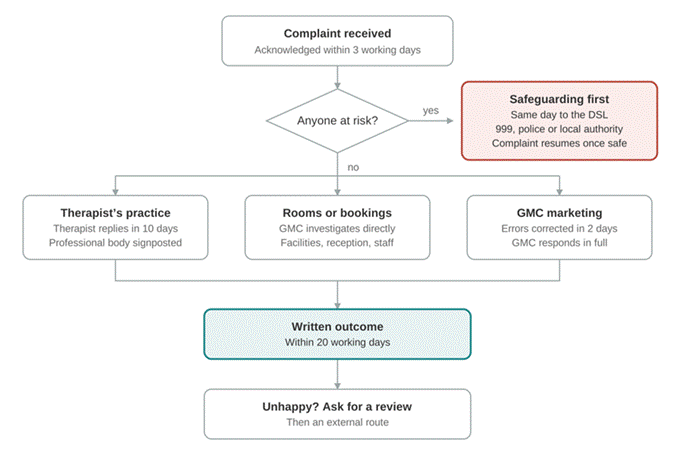
Where a complaint touches more than one route, GMC handles each part on its own route and sends one combined response.
5. Complaints procedure
The formal procedure has three stages after optional early resolution. A client can start at stage 1 and never has to approach the therapist first.
| Stage | What happens | Who | Timescale |
| 0. Early resolution (optional) | The client raises the concern directly with the therapist. This is never expected where the complaint concerns conduct, boundaries or safeguarding. | Client and therapist | As agreed |
| 1. Receipt and triage | The complaint is logged and acknowledged. GMC checks for risk, decides the route (section 4) and asks for consent to share details with the therapist. | Complaints Lead | 3 working days |
| 2. Investigation and response | Centre or marketing matters: GMC investigates. Therapist matters: the therapist responds in writing within 10 working days; GMC shares the response with the client and decides on any centre action. GMC sends a written outcome. | Complaints Lead | 20 working days |
| 3. Review | A client who is unhappy with the outcome asks for a review. Someone not involved so far reviews the handling and the decision. Their decision is GMC’s final position. | Independent reviewer | Request within 20 working days; decision within 20 working days |
If more time is needed the Complaints Lead writes to the client before the deadline, explains why and gives a new date.
The written outcome states:
- what was complained about
- what GMC found or what the therapist said
- any action GMC has taken or will take
- how to request a review
- where to go next if the client remains unhappy
External routes are open after stage 3 or at any time:
| Matter | Where to go |
| The therapist’s practice or conduct | The therapist’s professional body or regulator |
| NHS-funded therapy | The NHS provider’s complaints procedure, then the Parliamentary and Health Service Ombudsman |
| Personal data | The Information Commissioner’s Office (ICO) |
| Misleading advertising | The Advertising Standards Authority (ASA) |
| A possible crime | The police |
| Fees or the service contract | Citizens Advice or the small claims court |
Unreasonable behaviour: GMC will not tolerate abuse of staff or therapists. Where contact becomes persistently unreasonable or abusive, the Complaints Lead may limit it to one channel and will explain this in writing. The complaint itself is still answered.
6. Centre actions, confidentiality and records
GMC’s own decisions about a therapist are limited to room hire and marketing. They are proportionate to the concern and are written into every therapist’s agreement (Appendix A).
| Level of concern | Possible centre action |
| No case to answer | No action; the client is told why |
| Minor | Informal advice or a written reminder of GMC’s expectations |
| Moderate | Evidence requested of supervision, training or insurance; marketing paused until it is provided |
| Serious | Profile removed and room hire suspended pending the professional body’s outcome |
| Serious misconduct found | Agreement ended under its terms and the professional body notified |
Fairness to therapists: the therapist is told about the complaint (with the client’s consent), can respond in writing and receives GMC’s decision in writing. They may ask Louise Fenton to reconsider once within 10 working days.
Marketing accuracy: any inaccurate claim on the website, social media or a therapist profile is corrected within 2 working days of being identified. GMC checks each therapist’s listing against their professional body’s register every quarter and follows the CAP Code for advertising claims.
Confidentiality and data: GMC is the data controller for the complaint records it holds; each therapist is the controller for their own client records. Complaints often include health information, which is special category data under UK GDPR. Access is limited to the Complaints Lead, the DSL and the reviewer.
Records: every complaint is entered in a secure complaints log with the date received, route, actions, timescales met and outcome. Complaint files are kept for 6 years after closure, then securely destroyed. Safeguarding records may need to be kept longer; the DSL takes advice.
Review: Louise Fenton reviews the complaints log each year for themes and shares lessons with therapists without identifying anyone. This policy is next reviewed by 22 October 2027.
Appendices
Appendix A: Clauses for therapist agreements
Every therapist agreement requires the therapist to:
- hold current membership of a recognised professional body and give GMC their registration number
- hold professional indemnity insurance and provide a copy each year
- hold an enhanced DBS check where they work with children or adults at risk
- complete safeguarding training and follow this policy
- give clients their own complaints procedure and professional body details at the start of therapy
- tell GMC within 5 working days of any complaint to their professional body, any restriction on their practice or any police investigation
- respond to GMC about a complaint within 10 working days
- accept that GMC may pause marketing, suspend room hire or end the agreement under section 6
Appendix B: Complaint form fields
- Name and contact details, with preferred contact method
- Therapist’s name (if relevant)
- What happened, with dates
- What outcome the client is looking for
- Consent to share details with the therapist (yes or no)
- Is anyone at risk now? (yes or no)
- Any support or adjustments needed to take part
Appendix C: Contacts to complete
| Role or agency | Name | Phone | |
| Complaints Lead | Louise Fenton | 07907 613600 | info@greymatterscentre.co.uk |
| Designated Safeguarding Lead | Louise Fenton | 07907 613600 | info@greymatterscentre.co.uk |